Diamond Dove
Living with Diamond Doves
I came to diamond doves sideways — my partner bought a pair on impulse and declared them "easy." That was four years ago. I've stopped using the word "easy" about any bird. But I've also never kept a species quite so consistently rewarding to observe. This is what I've learnt.
Where It All Began
The Smallest Dove from Australia
The diamond dove (Geopelia cuneata) is the smallest member of the Columbidae family found in Australia and one of the smallest doves in the world. Wild birds typically weigh between 23 and 32 grams — you can lose one in the palm of your hand. They're found across the arid and semi-arid interior of mainland Australia, from the Kimberley coast across the Northern Territory and into Queensland, New South Wales, and South Australia, wherever water sources can be found. They're famously nomadic, following rainfall across vast distances in a way that makes their breeding behaviour in captivity particularly interesting.
In the wild, diamond doves live in open, dry habitats: spinifex grassland, mulga woodland, the edges of dry riverbeds. They feed almost entirely on small grass seeds, gleaned from the ground, and they drink frequently — several times a day in hot weather. This desert ecology explains a great deal about how they behave in captivity and what they need. A diamond dove that can't access fresh water daily is a diamond dove in difficulty.
The name comes from the white spots rimmed in dark on the wing coverts, which glitter like small diamonds in good light. They also have a very distinctive and beautiful orange-red eye ring — vivid against the blue-grey plumage — which is one of the first things that strikes you when you see a bird up close. Cock birds have a broader, more intensely coloured eye ring than hens, which is the most reliable visual sexing guide in the nominate (wild-type) form.
~ 27g
AVERAGE ADULT WEIGHT
5–10
YEARS TYPICAL LIFESPAN
19 – 21cm
BODY LENGTH
Colour Mutations: What's Available
Plumage variaties
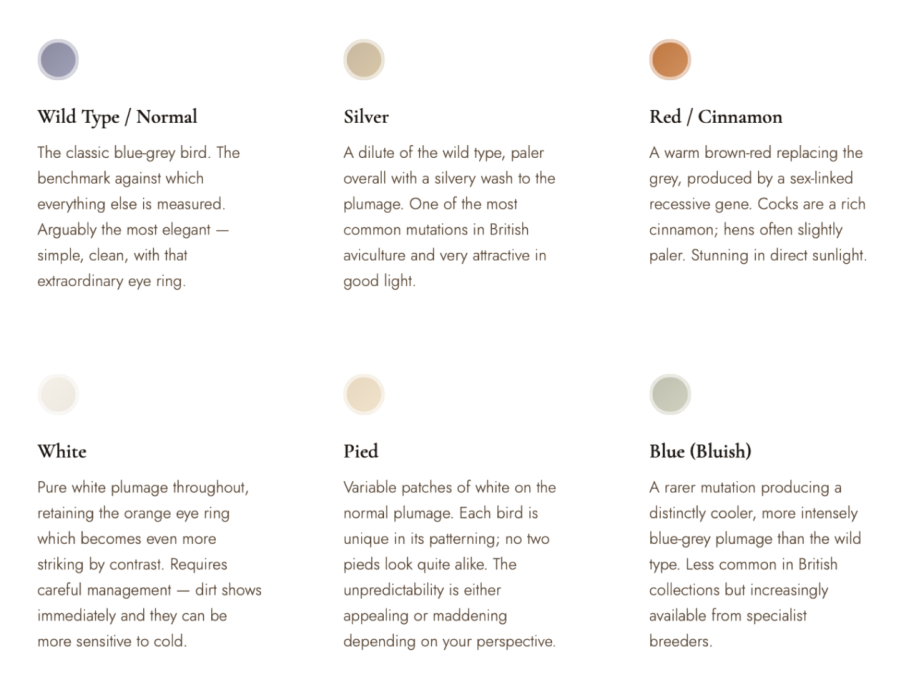
The wild-type diamond dove — blue-grey above, pale below, white-spotted wings, vivid orange eye ring — is already a beautiful bird. Decades of selective captive breeding have produced a range of colour mutations, some subtle and elegant, others more dramatic. I've kept several mutations alongside wild types, and each has its devotees. My own preference leans toward the wild-type, but that's entirely personal.
A note for newcomers: mutation terminology can be confusing because different countries and different breeders sometimes use different names for the same mutation. The names below are those most commonly used in British aviculture.
Understanding What They're Actually Doing
Behaviours & Characteristics
Diamond doves are, in my experience, one of the most behaviourally transparent birds you can keep. Once you learn their vocabulary — and it doesn't take long — you can read a bird's mood, health, pair-bond status, and breeding condition from across the room without disturbing them at all. This readability is one of the things I find most satisfying about them.
They're ground-oriented birds by nature. Even in a large aviary with plenty of perches, you'll frequently find them on the floor, moving in that characteristic quick, nodding walk, investigating every corner. In the wild this is entirely logical — that's where the seeds are. In captivity it means the floor of their housing matters: surface, cleanliness, and substrate all affect their wellbeing more than is sometimes appreciated.
The bow-coo display
The cock's primary courtship behaviour — a deep, repeated bow paired with a resonant cooing call, performed in front of or near the hen. When you first hear a diamond dove coo in earnest it's unexpectedly loud for such a small bird. If the hen is receptive she'll crouch and allow the cock to mount; if she's not, she'll simply walk away, usually with an air of considerable indifference.
Mutual preening
A well-bonded pair will preen each other around the head and neck — areas the bird can't reach itself. This is one of the most reliable indicators of a stable pair bond and good general condition. If a previously bonded pair stops preening each other, something has changed and it's worth investigating: illness, stress, or a breakdown in the relationship. I've used this signal to catch developing health issues early on several occasions.
Sunbathing
Diamond doves sunbathe with an enthusiasm that alarms newcomers. A bird lying on its side with one wing partially extended, eyes half-closed, looks for all the world as though it has keeled over. It hasn't. They're thermoregulating and thoroughly enjoying themselves. If you keep an outdoor aviary with any sun access, you will see this regularly in warm weather. It's worth memorising the difference between a sunbathing bird and a genuinely unwell bird so you don't cause unnecessary panic.
Wing-spreading alarm
When startled or threatened, diamond doves will sometimes drop from their perch and spread both wings against the ground in a dramatic display. This is a distraction behaviour — in the wild, it draws a predator's attention while the bird attempts to escape. In captivity, it usually means something has genuinely frightened them: a cat at the aviary wire, a large shadow overhead, an unexpected loud noise. A bird that repeatedly does this without obvious cause may be in a chronically stressed environment.
Nest calling
As breeding season approaches, cocks will often sit at or near a preferred nest site and produce a distinctive, lower call — different in tone from the courtship coo. This is essentially an advertisement: "here is a nest, come and look at it." The hen's response to this tells you a great deal about whether a pair is ready to breed. A hen that visits and sits near the nest site alongside the cock is very likely to go to nest within a week or two.
Feather fluffing
A warm, settled bird will often fluff its feathers slightly and tuck its head back while resting. This is entirely normal thermoregulation. A bird that is fluffed, sitting low, with eyes partially closed and not in the middle of obvious rest — particularly if this persists — is a bird to watch carefully. Combined with any reduction in feeding or droppings changes, it means an avian vet visit, not a wait-and-see.
How I Keep My Birds Well
Husbandry
Diamond doves are frequently described as "ideal beginners' birds" in general pet care literature, and in some respects that's fair — they're not fragile in the way a waxbill is, they don't need the complex temperature management of a Gouldian, and they breed readily. But small doesn't mean low-maintenance, and some of the most common mistakes I see come from that assumption. The basics below are genuinely the basics; each one matters.
🌡 Temperature
Diamond doves are more cold-tolerant than many tropical aviary birds but should not be kept below 8–10°C for sustained periods. I consider 12°C the safe minimum for my outdoor birds in winter, with a heated shelter maintaining at least 15°C overnight. They're sensitive to draughts even at reasonable temperatures — airflow management matters. In summer they genuinely thrive outdoors and handle British warm weather well. Watch humidity: desert birds in persistently damp conditions are susceptible to respiratory problems.
🏠 Housing
The minimum cage size for a single pair is 90 cm × 45 cm × 45 cm, and that's genuinely a minimum. Diamond doves are active birds and they need horizontal flight distance. Many keepers house them in larger flights or aviaries; an outdoor aviary in summer is excellent if there's a heated shelter to retreat to. Ther are much more active, more natural pair interaction. Perches at multiple heights, including some near ground level. Bar spacing no wider than 1 cm.
A small foreign finch seed mix forms the core — panicum millet, white millet, canary seed, and fine mixed grain. Grit and cuttlebone must always be available; doves need grit to grind seed in the gizzard and calcium for eggshell production. I supplement with greens and occasionally small amounts of egg food during breeding and moult. Live food is not needed or particularly appreciated by diamond doves, unlike most estrildids. Fresh water two to three times daily in summer — they drink frequently and in warm weather the water needs to be clean.
🌾 Diet
🧹 Hygiene
Diamond doves spend a great deal of time on the floor, which means floor hygiene matters more than with perching birds that rarely descend. I use wood chippings and pebbles — it's easy to spot-clean, drains well if used outdoors. Full clean once a week minimum; spot clean daily. Nest boxes should be cleaned between breeding attempts, not mid-cycle unless there's a health reason. Dirty water vessels are the single fastest route to disease in my experience.
💧 Water & Bathing
Fresh drinking water is non-negotiable — change it at least once daily, twice in warm weather. Unlike finches, diamond doves will bathe in a very shallow dish: provide one several times a week, no deeper than 1 cm. Some birds are enthusiastic bathers; others barely use it. Don't confuse reluctance to bathe with thirst — drinking and bathing are separate behaviours and both must be accommodated. I use continous running water feature with various depths.
🩺 Health
The most common health issues I've encountered: canker (trichomonosis) — a crop infection causing a cheesy yellow deposit in the throat, highly treatable if caught early; trichomoniasis from infected seed or contaminated water; respiratory infections associated with draughts and cold damp conditions; and egg-binding in hens, particularly young hens breeding too early. Know the difference between a resting bird and an unwell bird. Find an avian vet before you need one urgently — diamond doves deteriorate quickly.
Breeding Diamond Doves: Enthusiasm, Managed
Reproduction
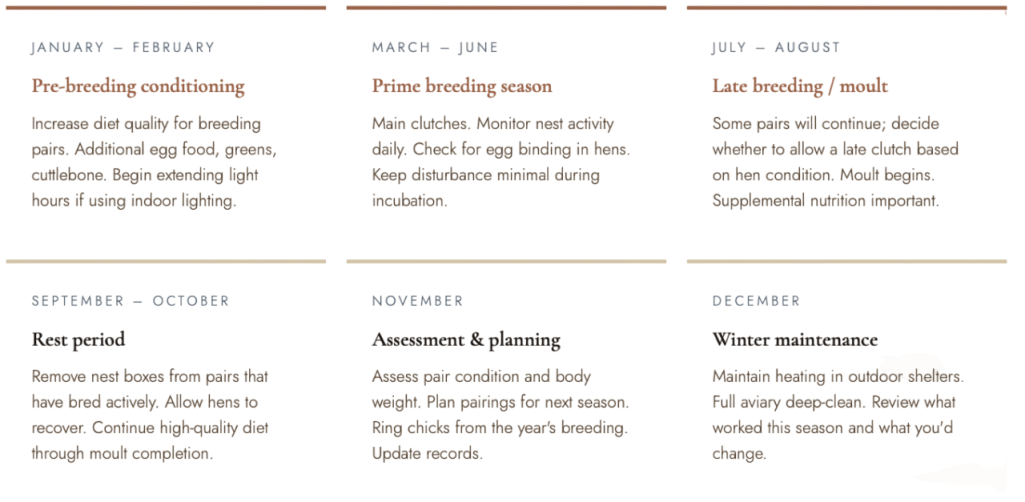
Diamond doves breed readily — possibly too readily. A fit, well-housed pair in good condition will attempt to breed almost year-round if you let them, cycling through clutches every five to six weeks. This sounds appealing until you realise that unrestricted breeding is hard on the hen, can produce poorly conditioned chicks, and results in young birds arriving faster than you can responsibly rehome them. Managing their breeding cycle is as important a skill as encouraging it in the first place.
The eggs — usually two, occasionally one — are white and surprisingly small even for the size of the bird. Incubation takes approximately 13 to 14 days, shared between both birds: the cock typically sits from mid-morning until late afternoon, the hen through the night and early morning. This division of labour is worth noting because disruption to either bird during incubation — illness, stress, an incompatible cage-mate — can cause abandonment even at a late stage.
Chicks hatch helpless and are fed on crop milk by both parents for the first week of life. This crop milk — not actually milk but a protein and fat-rich secretion from the crop lining — is the only food chicks receive in the first few days, which is why a hen in poor nutritional condition before and during breeding produces chicks that fail to thrive. The link between hen condition and chick survival is direct and unforgiving.
A note on nest boxes
Diamond doves in the wild nest in low shrubs and on the ground, building a flimsy, almost laughably insubstantial platform of grass stems. In captivity, they'll use open-fronted nest boxes, canary nest pans, or even a small tray of twigs — they're not particular. I use small open-fronted wooden boxes (approximately 15 × 15 × 12 cm) positioned at various heights, because different pairs seem to have different preferences for nest height. Provide nesting material: fine dried grass, coconut fibre, small twigs. They'll build something that looks as though it would disintegrate in a breeze; try not to interfere with it.